
Hi friend,
I want to tell you about somewhere I went recently.
I visited an outdoor school in Kenya. No walls. The classrooms were trees. The day moved by light and weather rather than bells. Children moved between activities at a rhythm that belonged to them, not to a timetable someone in a head office had drawn up. Older children were not separated from younger ones — they were in the same space, in the same time, learning differently from each other and from the adults around them. The adults were not standing at the front of anything. There was no front.
I was there as a parent. I was also there as someone who has worked in education for two decades, in classrooms in London and in emergency settings.
Still learning. Just not how we all see school.
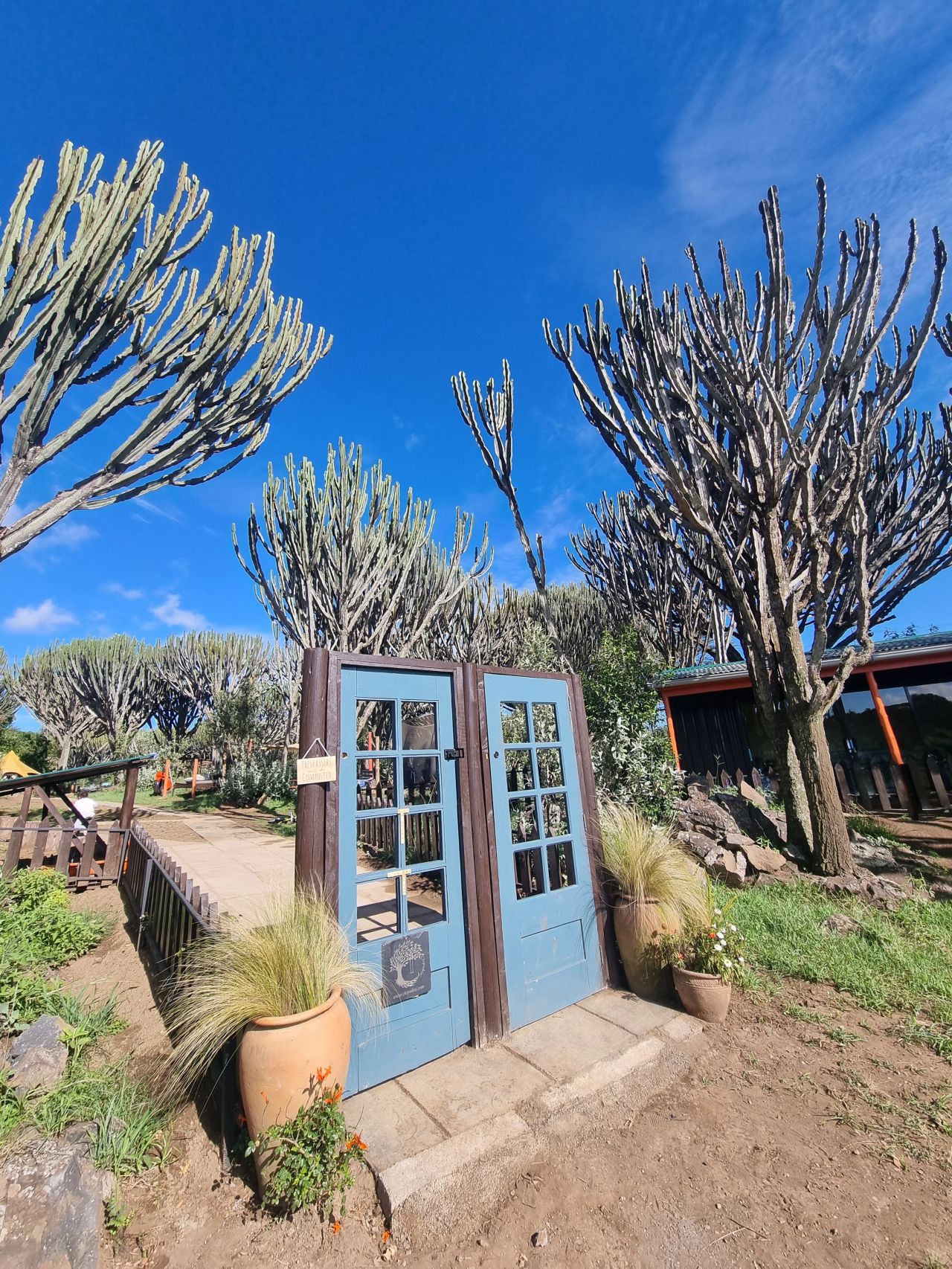
I keep returning to the space itself. Not the curriculum, not the pedagogy, not the founder's articulate description of the method. The space.
Because what I saw was that the design of the space had already done most of the political work before anyone opened their mouth. There were no walls to enforce who belongs in which room. There was no front of the class to enforce who speaks and who listens. There were no desks in rows to enforce who faces whom. The structure of the day did not assume that learning was a thing transferred from an adult who has it to a child who does not. The trees were not a backdrop. They were the room.
Sasha Costanza-Chock writes that the who of design determines the what. I would add: the where of design determines what is even imaginable from inside it. The architecture of the classroom — four walls, rows, a raised platform, a clock on the wall — is not neutral. It is an argument about what learning is and who controls it. You cannot have a different pedagogy inside the same architecture for very long. The architecture wins. The architecture always wins.
This school had refused the architecture. And in refusing it, everything downstream became designable differently — the rhythm, the relationships, the role of the adult, the child's relationship to her own attention.
I have spent my career inside a sector that uses the word innovative constantly. We have all read the proposals. We have all written them. The word appears so often it has become almost meaningless — a stamp we put on something to make it fundable. Communities have to rebrand their ancestral practices as innovative just to get noticed. Open-air learning, multi-age groups, learning by season and weather and proximity — these are not new. They are older than any building any of us has ever sat in.
What I saw in Kenya was not innovative. It was honest about what learning actually is. The innovation framing is what gets put on it from the outside, by people whose own architecture they are unwilling to question.
The real question that school was asking — without saying it out loud — was the room question. Which room was this designed in, and who was already in it? The answer at this school was: a room with no walls, and the children were already in it. Everything else followed.
Try this week
Here is the practical piece — because this newsletter is meant to be useful before it is meant to be anything else, and because the room question is not abstract. It is the most material question you can ask of your own work.
Take a proposal/initiative/project/idea you are working on this week. Any proposal. Find the section that describes the design process — methodology, approach, co-design, community engagement, theory of change, whatever the donor's template calls it.
Now make a small table on a separate page. Two columns. Don't put it in the proposal. This is for you.
Column one: every decision that has already been made about this programme. Budget total. Staffing model. Geographic scope. Timeline. Implementing partner. Outcome indicators. Reporting cadence.
Column two: who was in the room when each decision was made.
That's the exercise.
What you will find — what I find every single time I do this — is that the most consequential design decisions were made in rooms that did not include the people the programme is supposedly for. The "participation" described later in the document is happening on top of a structure that was already closed. Like a classroom with rows already bolted to the floor, and then a teacher being asked to teach democratically inside it.
The exercise is not to fix this in the proposal. It is to notice the architecture and really reflect on who designs and signs your proposals.
The exercise is to see it clearly, in writing, in your own handwriting. So that the next time you are at the front end of a design — the moment when a funder calls, when a partner pitches, when an idea is taking shape inside your organisation — you can ask the room question early enough that the answer can still be different.
You can ask: do we need walls here at all?
That noticing is where different design begins.
I am writing this from Mauritius, behind a sugar factory and a field of cane.
The view is beautiful. Sugar cane is also beautiful. And sugar cane has a history that this island has not finished reckoning with — a history of who designed this landscape, for whose benefit, and who was never supposed to survive it, let alone shape it.
The Maroons did not wait for permission to design differently. Escaped, hunted, living in the mountains and the forests that the plantation economy had no use for, they built governance structures, care systems, and ways of organising life that the architecture of enslavement said were impossible. They did not have walls either. What they had was a refusal to accept that the only world available was the one someone else had designed for them.
I think about this every time I drive past those fields. I think about it when I write proposals. I think about it now, having stood in a school in Kenya with no walls and watched children learn in a way my own schooling would have called impossible.
The room was the lesson. It is always the lesson.
Until next time.
Jess
P.S. The Designing Otherwise Accelerator opens for its June cohort on 5 June . Eight weeks. Capped at twenty. We work through exactly this kind of question — proposals as political acts, the participation trap, budget as design, constructive complicity — with practitioners from across thirty-plus countries. Payment plans available, and parity pricing for Global South participants. If this piece resonated, you already know whether the room is for you. → https://www.designforsocialimpact.io/designforsocialimpactaccelerator
P.P.S. Before you decide — join us this Friday 22nd for a free taster session: Programmes as Political Design. One hour. Live. Bring a programme you're working on. Sign up here
P.P.P.S Check out our new, improved and FREE participatory budget tool. Download as Excel or PDF. Yours to keep.


Responses