
Design programmes
you're not ashamed of.
The Programme Design Studio is a guided design tool for teams — six stations that walk you through a programme from positionality to afterlives, and won't let you skip the question that decides everything else. It runs entirely on your own machine, and it hands you a design document you can take into the room.
Get the Studio — from £67
You already know what good design looks like. You're just rarely allowed to do it.
There is a particular kind of programme design that gets funded. It's sleek. It's scalable. It has a theory of change that moves in clean, linear arrows, and it uses the word innovative at least three times before page two. And it is, very often, describing something the community has been doing for years.
We've all written that version. The "capacity building" line that assumed a deficit where there was a tradition. The co-design process that was really consultation. The logframe we knew was a fiction, filled in anyway. We write the version that gets funded, and we file the version we believe somewhere we don't have to look at it.
The problem was never that you lacked a template. The sector is drowning in templates. The problem is that almost none of them ask the question that decides everything else: who is in the room when this gets designed, and whose knowledge are we treating as the starting point?
This tool asks it. And then it won't let you skip the answer.

Not a form. Six questions you can't route around.
A form accepts whatever you type. The Studio notices what you're avoiding, because it asks the questions in an order that makes avoidance visible.
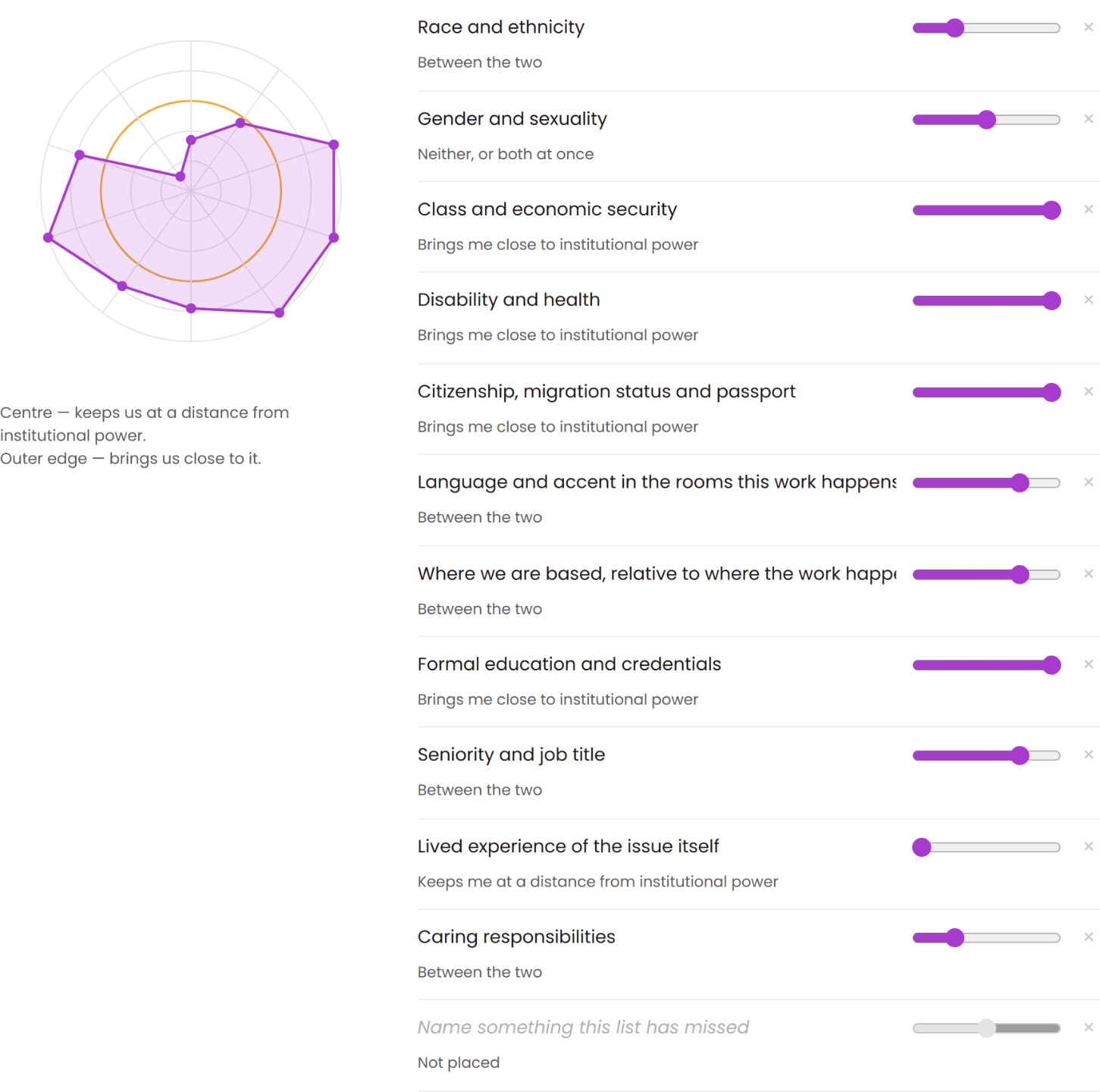
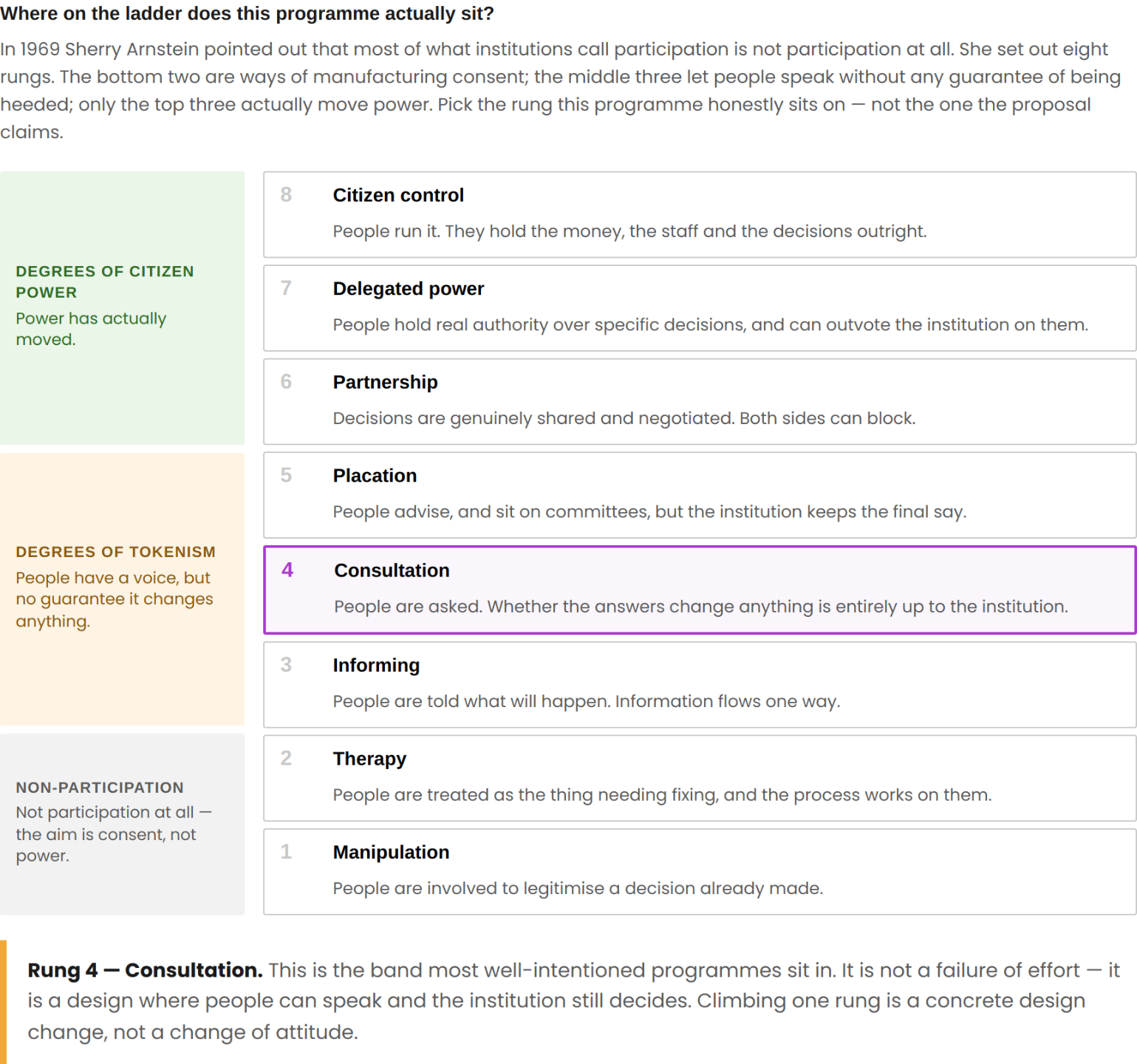
You work through six stations. Locate puts the design team's own position on the table before anything else — including a positionality wheel that asks how each part of who you are brings you closer to institutional power or keeps you at a distance from it, in relation to this issue specifically. Name takes the page you would actually send to a funder and reads it back to you, hunting for the deficit language that quietly relocates the problem into people. Decide puts your programme on Sherry Arnstein's ladder of participation and asks you to pick the rung you honestly sit on, not the one the proposal claims.
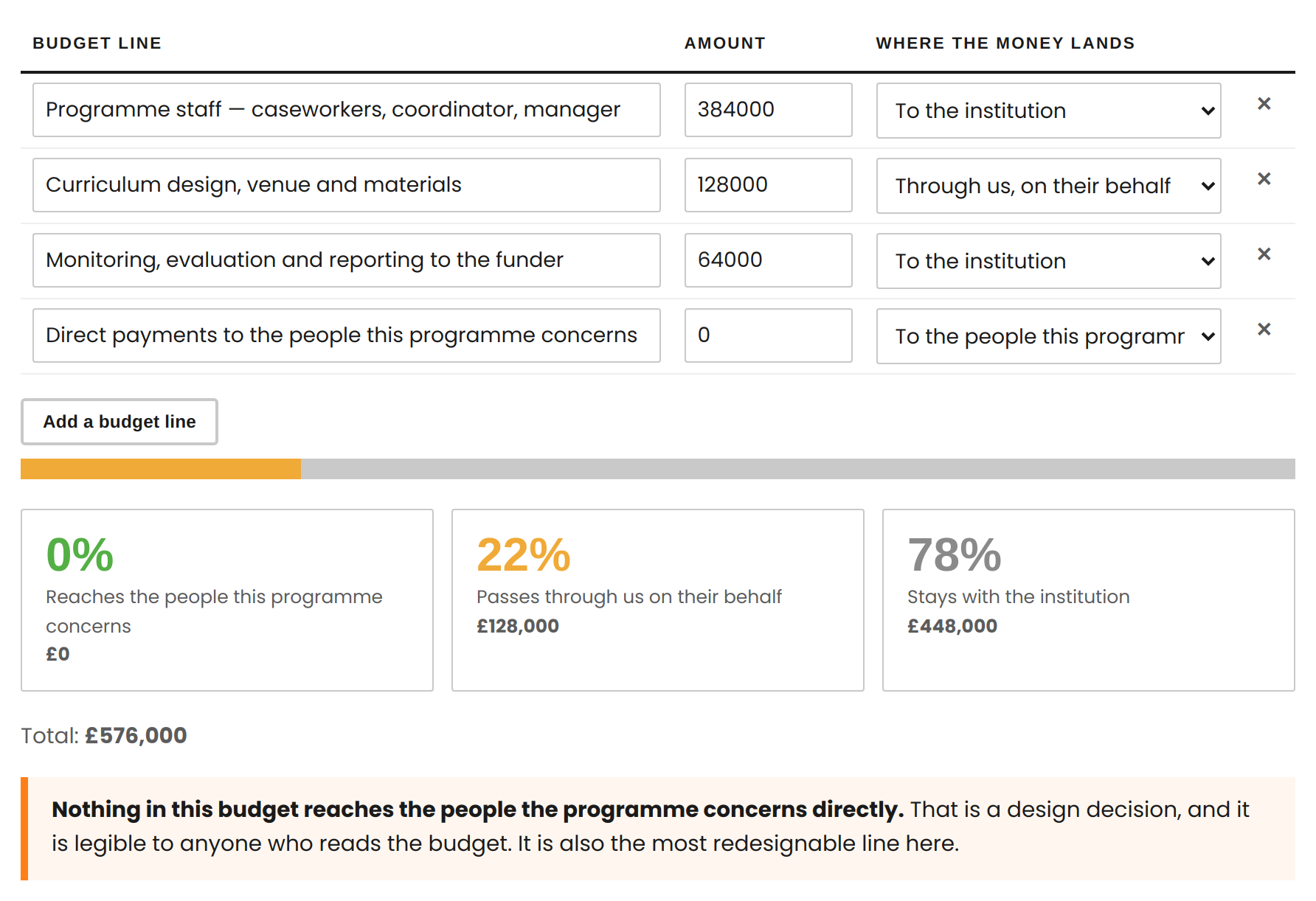
Resource treats the budget as what it is — the real theory of change — and shows you what proportion of the money reaches the people the programme concerns as money, rather than as services delivered to them. Bound sets the floor nobody involved should fall below and the limit the work must not exhaust. Grow back asks what remains when the funding ends, and in whose hands.
Each station closes with a short test written for that station: the money test, the teeth test, the exit test. At the end, one last test on the whole design, building on the foundations of André Gorz and Ruth Wilson Gilmore — does this move power, or does it settle things as they are?
You mark where the design sits when you start, and again when you finish. The distance between those two marks is usually the most useful thing in the session.
How it works
You work the six stations in order, on a programme you are actually designing — or one you are about to renew. It works on existing designs too, and most of the useful findings come from work already underway.
Nothing is uploaded. Nothing is sent. The Studio runs in your browser with the internet switched off, on a laptop or a phone. There is no account, no login, and no server holding your community's data.
On your own or with your team. Put it on a screen in workshop mode — larger type, a built-in timer — and work a station at a time out loud with three to six people. Or work separately: each person completes their own pass, downloads it as a small file, and whoever is facilitating merges everyone's passes together. The Studio then shows where the team agrees and, more usefully, where you don't. The disagreements are the discussion.
Why a team needs this
Most design tools help you produce the document faster. This one slows you down at the four or five moments where slowing down changes what actually gets built — who was in the room, what the language is doing, where the money lands, and what remains when the funding stops.
It works the way a critical friend does when they have read your proposal properly. It does not tell you the design is good, and it does not tell you it is bad. It asks the questions a colleague would ask if they were being completely honest with you — and it keeps a record of how you answered.
This is what you're actually buying.
Three of the six stations, as they look when a team is working in them.
Station 01 — the positionality wheel
Twelve lines, all editable, all optional. Each one asks what brings you closer to institutional power on this issue and what keeps you at a distance. It produces no score and no ranking — the shape is the finding.
Station 03 — the ladder of participation
All eight of Sherry Arnstein's rungs, each explained in plain language. Pick the one your programme honestly sits on. Land in the tokenism band and the tool tells you what climbing one rung would actually take.
Station 04 — the budget as design
Enter the real lines and say where each one lands. The Studio does the arithmetic and shows what share reaches the people the programme concerns as money. A £0 line gets named, without comment.
Why does an organisation need this?
Because the parts of programme design that decide who holds power are the parts most templates never ask about.
It pushes on the language
The words a proposal uses decide who gets fixed and who stays unexamined. The Studio takes the page you would actually send and reads it back to you, hunting for the deficit language that quietly relocates the problem into people — then asks what would have to change in the programme, not just the wording.
It moves the argument to the budget
Whoever controls the budget controls the idea. It is easy to agree in principle that power should shift and much harder to move a line. This is where that conversation becomes concrete: what proportion reaches people as money, who decided the split, and who could move a line later if the work needed to change.
It makes your team's disagreements visible
Everyone works their own pass and the Studio merges them. Where three colleagues answered the same question differently, you see it — and that is usually the conversation the team has been avoiding. Agreement reached without noticing the disagreement is not agreement.
None of this makes the design harder to fund. It makes it harder to write something you would be embarrassed to show the people it concerns.
What you walk away with
Not a saved form. Three documents, generated from your own answers, that carry the thinking into the rooms where decisions get made.
A design readout:
every station, every answer, and a list of the specific points where the design currently leaves things as they are. Not a score — the list of things you can change, with the questions that surfaced them.
A Word design document:
the whole thing laid out as a proper document in DFSi's type and colour, ready to walk into a team meeting, a board paper, or a funder conversation.
An Excel workbook:
a sheet per station, a budget sheet that does the direction-of-resources arithmetic for you, and — if you have merged a team's passes — a sheet showing exactly which questions your colleagues answered differently.
They open in Word, Excel, Google Docs and Google Sheets.
They are yours, on your machine, in formats your organisation already uses.
The politics are in the tool, not just the marketing
Most tools hide their politics. This one puts them in the questions.
There is no field anywhere in the Studio called "beneficiaries". The people a programme concerns are described as the people it concerns, and the budget station asks how much money reaches them as money. The participation station asks the question most participation frameworks avoid — whether a no can hold, and what happens to someone who says it. There is a station on data: who holds a veto over what gets collected about people, and what people are able to refuse. And the budget note carries the wisdom fund — a flexible line that pays for the community knowledge most budgets extract for free, named however your funder's template will accept it.
The positionality wheel produces no score. It does not rank anyone, and it does not total. It has one job: to make visible which parts of who we are open doors in this work and which parts close them — and where our own reading of that differs from a colleague's.
None of this shows up as a feature you can sell. It's the whole point.
This is for you if —
You design programmes inside institutions that were never built for the politics you hold. You've read some of the books — Roy, Rodney, Gilmore, Costanza-Chock — and you have more of the analysis than you usually get to use. You're tired of templates that ask none of the real questions, and tired of being the only one in the room who thinks this way.
You don't need to have read everything. You need to have felt the contradiction.
This was built by someone still in the work alongside you — not above it.
Be the First to Know
Join the waitlist for early access and be the first to hear when The Programme Design Studio is officially live. Waitlist members will also receive an exclusive discount.
Where this sits:
If you're not ready to buy, start free: the Social Impact Budget Builder is our lead-magnet tool and a good way to feel how we work: https://www.designforsocialimpact.io/budget-builder-tool-opt-in
And if you'd rather go deeper — with a room full of people who think the way you think — that's what the Designing Otherwise Accelerator is for. Eight weeks, capped at 20, with bursaries. Previous cohorts have spanned 30+ countries. The canvas is the tool; the Accelerator is the room: https://www.designforsocialimpact.io/designforsocialimpactaccelerator
Is this just another template?
Do I need to be "radical enough" or have an academic background?
What's the difference between the £67 and the £97?
What happens to what I type in?
Can I use it with my team, or does everyone need a copy?
Does it work on my phone? Can my organisation buy it?
Refunds?
It won't fix the sector. It will change how your next design starts.
If you design programmes for a living, and you're tired of doing it inside tools that ask none of the real questions — this was built for you.
The first station takes fifteen minutes. It asks who you are in relation to this issue, and what is genuinely in your hands. Most people find that harder than they expected.